
The financial activities sector now has 129,000 fewer jobs than it did in May 2025.
That figure comes from the Bureau of Labor Statistics September employment report, released October 2, and most of the decline sits in one corner of the industry. Insurance carriers and related activities account for about 90,000 of the lost jobs.
Our first instinct with any headline about an entire industry is the same one we use on salary claims. Which version of the industry?
Finance covers bank tellers, claims adjusters, bond traders, and leasing agents, and the September numbers show those groups moving in very different directions.
What the September Jobs Report Actually Said
The number for the whole economy was weak. Employers added 29,000 jobs in September, according to the BLS Employment Situation summary, and the unemployment rate held at 4.2%. Economists had expected about 84,000 new jobs, as Quartz noted in its coverage of the report.
In this video, Kevin Hincks of Schwab Network breaks down the September 2026 U.S. jobs report and discusses what the latest employment figures could mean for financial markets.
His analysis provides additional context for the broader labor market slowdown, as the financial activities sector continues to experience significant job losses.
Finance was one of the sectors moving backward.
Manufacturing moved in the opposite direction. While financial activities continued to shed workers, U.S. factories added 72,000 jobs since December 2025, showing how differently industries are responding to the same weak labor market.
Here is what the release says about it and about the months around it.
- Financial activities lost 7,000 jobs in September alone.
- The sector is down 129,000 jobs from its recent peak in May 2025.
- Insurance carriers and related activities make up about 90,000 of that decline.
- Revisions cut combined July and August payroll gains by 60,000, and July now shows a net loss of 10,000 jobs across the economy.
Revisions matter here because the finance totals from earlier months can shift as well.
Where Finance Jobs Disappeared Over the Past Year
A drop from a peak always depends on where you start counting, so we wanted a cleaner comparison.
The BLS employment table by industry lets you line up September 2025 against September 2026.
| Industry group | Sept. 2025 | Sept. 2026 | Change |
|---|---|---|---|
| Financial activities (total) | 9,189,000 | 9,082,000 | -107,000 |
| Insurance carriers and related activities | 3,006,400 | 2,930,400 | -76,000 |
| Credit intermediation (banks, credit unions, lenders) | 2,565,100 | 2,521,900 | -43,200 |
| Commercial banking (part of credit intermediation) | 1,373,000 | 1,347,500 | -25,500 |
| Securities, funds, and investments | 1,146,800 | 1,174,000 | +27,200 |
| Real estate and rental and leasing | 2,451,300 | 2,437,700 | -13,600 |
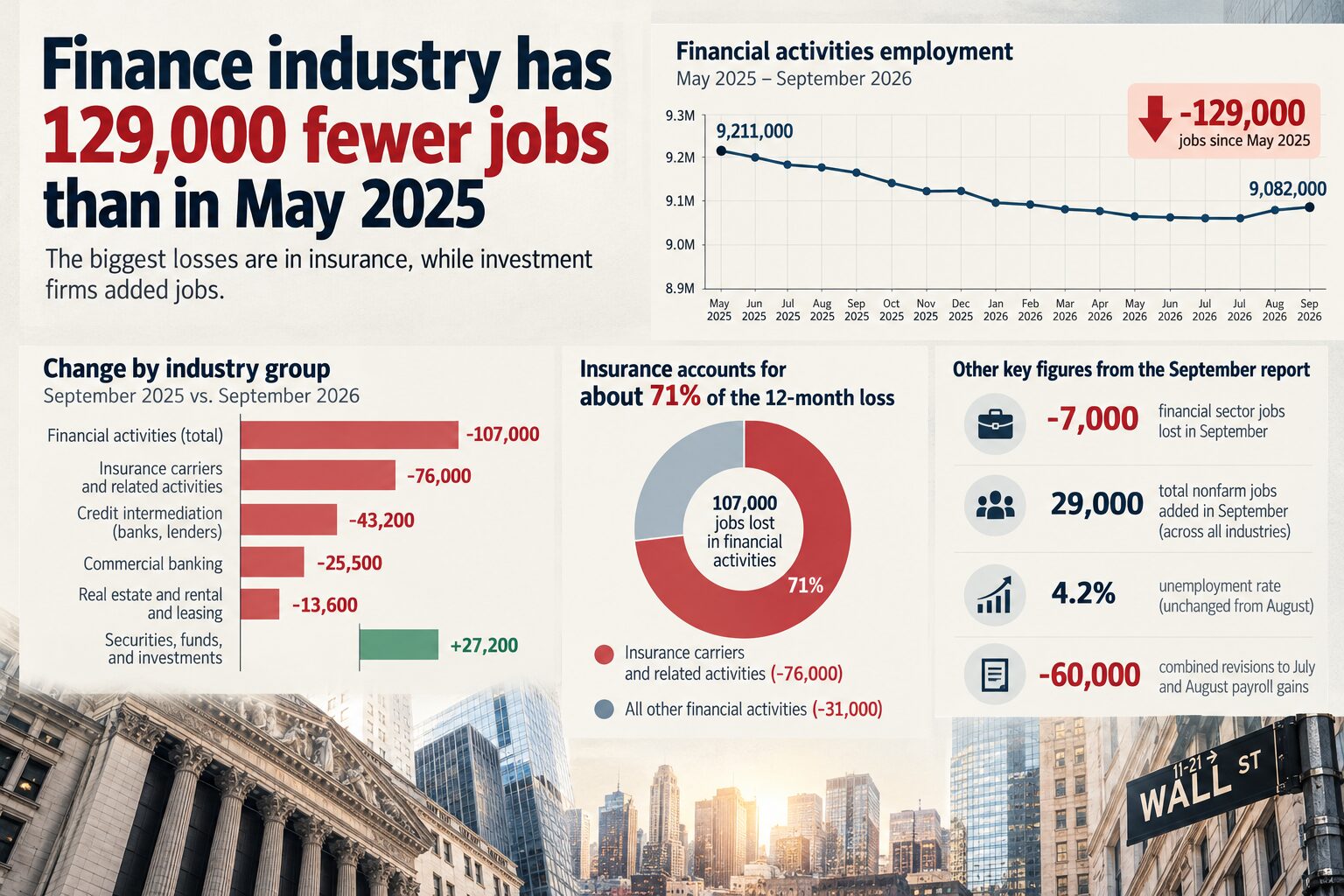
Insurance alone accounts for about 71% of the 12-month loss. Investment firms added jobs over the same period, which makes the sector total look milder than the losses in insurance and banking.
All figures are seasonally adjusted, and September 2026 numbers are preliminary.
Insurance Losses Now Top the Financial Crisis Count
Insurance employment has fallen for 11 straight months. The industry sits about 95,000 jobs below its February 2025 peak of roughly 3.03 million, according to an Insurance Business analysis of the BLS data.
This video examines the decline in financial sector employment, including the significant job losses among insurance carriers.
Between July 2008 and early 2011, insurance employment fell by 86,800 jobs, or 3.6% of the workforce. The current decline is about 95,000 jobs, or 3.2%. It is larger in raw numbers but smaller as a share.
Both statements are true. Insurance employs more people today than it did in 2008, so a bigger loss can still be a smaller percentage. The 95,000 figure also starts in February 2025, while the BLS figure of 90,000 starts in May, which explains the gap.
Distinctions like that rarely win over a dinner table. Anyone who has started a sentence with “technically” knows the look. Here, though, the distinction is the whole story.
Claims Workers Are Taking the Hardest Hit

Inside insurance, the damage is concentrated. Claims employment fell 20.9% from a year earlier through July, based on Jacobson Group data cited by Insurance Business.
Life and health carriers were down 4%, and property and casualty carriers were down 1.7%.
Carriers have not stopped hiring altogether. In the Jacobson and Aon Q3 2026 insurance labor market study, 49% of insurers planned to add staff and 11% planned reductions.
Companies planning cuts most often named automation as the main reason, followed by overstaffing and reorganization.
The same survey still lists technology, underwriting, and claims among the roles insurers need most. My reading is that carriers want fewer, more experienced claims staff rather than none.
Years of compensation work taught me that job titles hide a lot, and “claims” covers both a routine processing desk and a senior adjuster handling a complicated loss.
Banks Are Shrinking While Investment Firms Add Staff
Credit intermediation, the BLS category for banks, credit unions, and lenders, lost 4,600 jobs in September and about 43,200 over the year.
Commercial banking alone is down 25,500 from September 2025.
Securities and investment firms moved the other way, adding 27,200 jobs over 12 months and holding flat in September.
A teller and a portfolio analyst both count as finance workers, yet in 2026 they are living in different labor markets.
Even as bank payrolls shrink, commercial banks posted 48,859 jobs seeking AI skills in the 12 months before July 2026.
Demand rose 51% from a year earlier, based on Lightcast data analyzed by the Bipartisan Policy Center. Banks are hiring, just for different skills than the jobs they are cutting.
Hiring demand is only part of the shift. Wall Street firms are also changing how they evaluate existing employees, with some linking compensation and promotions to AI proficiency. The challenge is determining what counts as being good at AI on Wall Street when employers still lack a consistent way to measure those skills.
The growing importance of AI skills is also changing compensation. A separate survey found that some financial firms now tie raises, promotions, and bonuses to AI proficiency, making those skills relevant to both hiring and career advancement.
That distinction matters for new entrants, too. As the latest underemployment figures for college graduates show, earning a degree does not necessarily mean finding a job that requires one.
Pay Is Still Rising for the People Who Stayed
Average hourly earnings in financial activities reached $49.75 in September, up from $47.93 a year earlier, according to BLS earnings data by industry.
The 3.8% gain beats the 3.0% rise for all private workers and the 3.4% annual inflation rate reported for August.

A raise counts when it changes what a household can actually do that year.
In dollars, average weekly pay in finance rose $63.46, or about $3,300 over a full year.
One caution belongs here. Averages describe the people still on the payroll. When lower-paid roles such as claims processing disappear, the average can rise partly because the remaining group earns more.
Limits Worth Knowing Before Drawing Conclusions
We would rather spend a few sentences on the fine print than let one big number do all the talking.
Three limits stand out in this report.
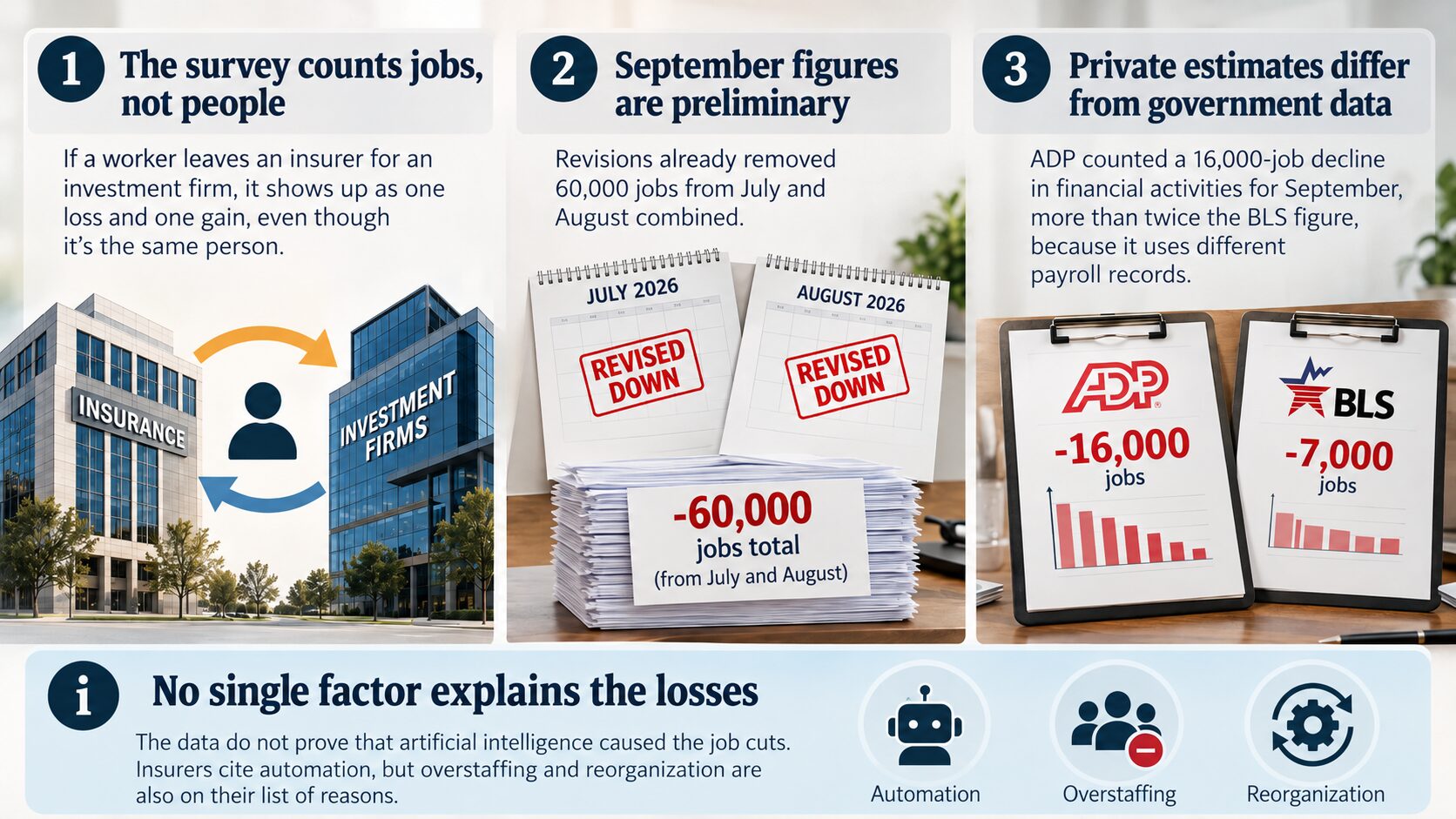
- The payroll survey counts jobs, not people. A worker who leaves an insurer for an investment firm shows up as one loss and one gain.
- September figures are preliminary, and revisions already removed 60,000 jobs from July and August combined.
- Private estimates differ. ADP counted a 16,000-job decline in financial activities for September, more than twice the BLS figure, because it draws on different payroll records.
No dataset here proves that artificial intelligence caused the losses. Insurers cite automation, but overstaffing and reorganization also appear on their list.
What Finance Workers Can Reasonably Do Now
If you work in claims, policy administration, or bank operations, the data argue for knowing your options before your employer makes the decision for you.
That does not mean quitting on a Monday. For most people, updating a resume while things are calm is the better move.
Liking your team is a good reason to stay in a job. It is not a plan when your job category shrank by a fifth in a single year.
For anyone weighing an offer in a growing area such as investments, compare take-home pay after housing costs. A raise that looks generous on paper can shrink quickly once rent enters the picture.
What to Watch in the Next Jobs Report
The next test comes on November 6, when the BLS releases the October employment report. We will be watching two lines in particular.
Insurance carriers and related activities would post a 12th straight monthly decline if the number falls again. Credit intermediation has lost jobs at a smaller but steady pace.
If investment firms keep adding workers while those two categories shrink, the 129,000 figure will look less like a finance slump and more like a reshuffle inside one industry.
So far, the September data show the cost landing hardest on claims and banking staff.