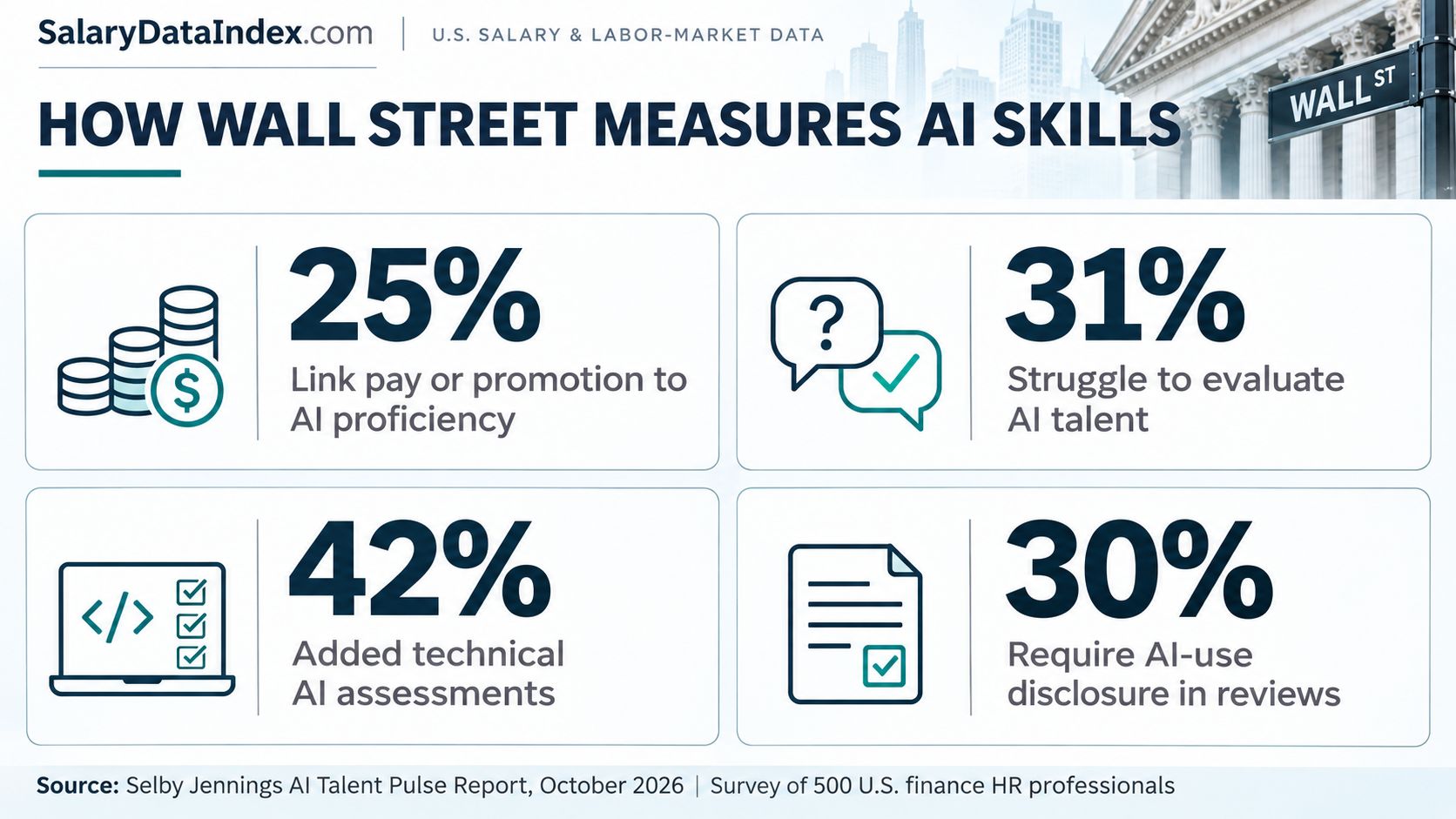
Being good at AI now counts toward pay at a growing share of finance firms. In a Selby Jennings survey of 500 U.S. finance HR professionals released October 14, 25% said their organization ties raises, promotions, and bonuses to AI proficiency. The same report admits the industry has no shared definition of proficiency.
So what are banks and investment firms actually measuring? We sorted the public evidence into four yardsticks, from training certificates to business results. Then we checked what each one can and cannot tell a manager. The easiest measure to collect turns out to be the weakest one.
Firms Want AI Fluency but Cannot Define It
The Selby Jennings AI Talent Pulse Report is blunt about the gap. Of its respondents, 16% do not know what “AI-enabled” means for the roles they hire for. Another 31% say the biggest roadblock to hiring AI talent is that nobody inside the firm can confidently evaluate candidates.
Firms are moving anyway. Dylan Gomez, an executive director at Selby Jennings, told Reuters that companies have gone beyond checking whether employees use AI tools and now monitor its effect on output. We think that is the right direction. Tracking output takes more work than counting logins, though, so many employers start with the easy number.
Our advice is to treat any AI rating at work as a measure of something specific, not a verdict on your skill. The useful question is which yardstick your firm relies on.
Wall Street firms are increasingly linking employee bonuses and career advancement to AI proficiency, raising questions about how those skills should be measured. Source: WION.
The central problem:
Financial firms are beginning to reward AI proficiency before agreeing on a consistent way to measure it. A training certificate, a usage dashboard, and a documented productivity improvement are three very different kinds of evidence.
The Four Yardsticks Firms Use
Public reporting on banks and other large employers points to four kinds of evidence, and each one leaves something out.
| Yardstick | Example | What it shows | What it misses |
|---|---|---|---|
| Training completed | Citi prompt training, 2025 | Familiarity with approved tools | Whether work changed afterward |
| Usage volume | JPMorgan dashboards rating engineers as non, light, or heavy users | How often tools are opened | Quality and necessity |
| Disclosure in reviews | Required by 30% of firms in the Selby Jennings survey | What employees say they did | Anything they leave out |
| Results | Amazon tracking AI-assisted code that actually ships | Value delivered | Needs a baseline to compare against |
Training is the floor. Citi required prompt training for most of its roughly 180,000 employees with access to its AI tools. Usage and disclosure show that AI is present. Only results show whether the work got better, which is why we think results should carry the most weight in pay.
Training proves preparation. Usage proves activity. Disclosure provides a record. Measured results offer the strongest evidence that AI is actually improving someone’s work.
Why Counting Usage Backfires
Usage dashboards are cheap to build, and they reward the wrong behavior. Business Insider reported in April that JPMorgan ranks engineers by their use of tools such as GitHub Copilot, with about 70,000 provisioned users and 24,000 active ones as of March. The bank said the data guides AI investment rather than formal reviews.
Amazon found the weakness quickly. After the Financial Times reported that staff were padding an internal AI leaderboard with pointless agent tasks, Amazon switched the tool off in late May and moved to tracking AI-assisted code that ships. Senior vice president Dave Treadwell told staff, “Please don’t use AI just for the sake of using AI.”
Goodhart’s law:
In its most cited form, it holds that when a measure becomes a target, it ceases to be a good measure. Set a usage target, and activity rises whether or not the work improves.
Feeling Faster Is Not the Same as Being Faster
Self-reported time savings are the other weak spot, because people misjudge them. The clearest evidence comes from software, but it applies to any review that asks employees to estimate their own AI gains.
In a 2025 randomized trial by the research group METR, 16 experienced open-source developers worked on 246 real tasks. They expected AI to make them 24% faster. With AI allowed, they actually took 19% longer, yet afterward they still believed it had sped them up by about 20%.
The study has limits. The sample was small, it used early-2025 tools, and METR has since labeled the results out of date and published newer data. Still, by our math the developers misjudged their own speed by roughly 39 points. Managers should ask for timed comparisons, not impressions.
Wall Street Already Grades Companies This Way
Investors have spent 2026 drawing the same line between spending on AI and earning from it. Second-quarter earnings season showed the pattern clearly.
- Amazon said AWS AI revenue passed a $25 billion annual run rate, and the stock jumped about 15% the next day, Barchart reported.
- Alphabet raised its planned capital spending to $200 billion earlier in the same cycle, and its shares fell.
- Amazon raised its own 2026 spending projection from $200 billion to $220 billion, yet investors focused on the revenue.
Our read is that the corporate scorecard is moving inside the firm. A bank that asks Amazon to prove AI revenue will eventually ask its own analysts to prove AI output, not AI activity.
Bloomberg Television examines how Wall Street leaders weigh the opportunities and risks of artificial intelligence as investment in the technology continues.
What Hiring Managers Treat as Proof
Hiring shows what firms value, because recruiters must test candidates on the spot. In the Selby Jennings survey, 42% of HR respondents said their organization added technical assessments to filter out candidates who overstate AI experience. Another 27% now use AI-conducted interviews for AI roles.
Fundamentals still count. A matching 27% rank passing interview assessments without AI as a highly sought qualification. PwC found a similar tilt among senior leaders. In its 2026 Financial Services Workforce AI Survey, 86% of U.S. executives said AI skills training is more valuable than an MBA for new hires.

For entry-level workers, the stakes are high. Recent graduates already face a weak market, with 42% working in jobs that typically do not require a degree.
How to Show Your AI Skill Before the Next Review
If your firm has added AI to the review form, we would build the evidence around results in five steps.
- Ask your manager which yardstick counts, whether training, usage, disclosure, or results.
- Pick one recurring task and record how long it takes before you change your process.
- Track the same task with AI for several weeks, including time spent checking and fixing output.
- Note errors you caught in AI output, since Selby Jennings advises firms to weigh AI fluency alongside independent judgment.
- Report the change in business terms, such as hours saved for a deal team.
Resist the urge to pad usage. A high dashboard score is easy to dismiss once a firm moves to results, and the finance sector has cut 129,000 jobs since May 2025. A record of real output is the safer bet.
Frequently Asked Questions
Bottom Line on AI Skill Ratings
Being good at AI on Wall Street can mean four different things, depending on who builds the scorecard. Training and usage are the easiest to count, and they say the least.
Results are harder to measure and say the most. In the Selby Jennings data, 42% of firms have created new guidelines for judging AI skill, so the definition is being written during this review cycle.
If your employer asks about AI this winter, bring a before-and-after example with numbers attached.
A dashboard score can be gamed, but an hour saved on a real task is hard to argue with.