
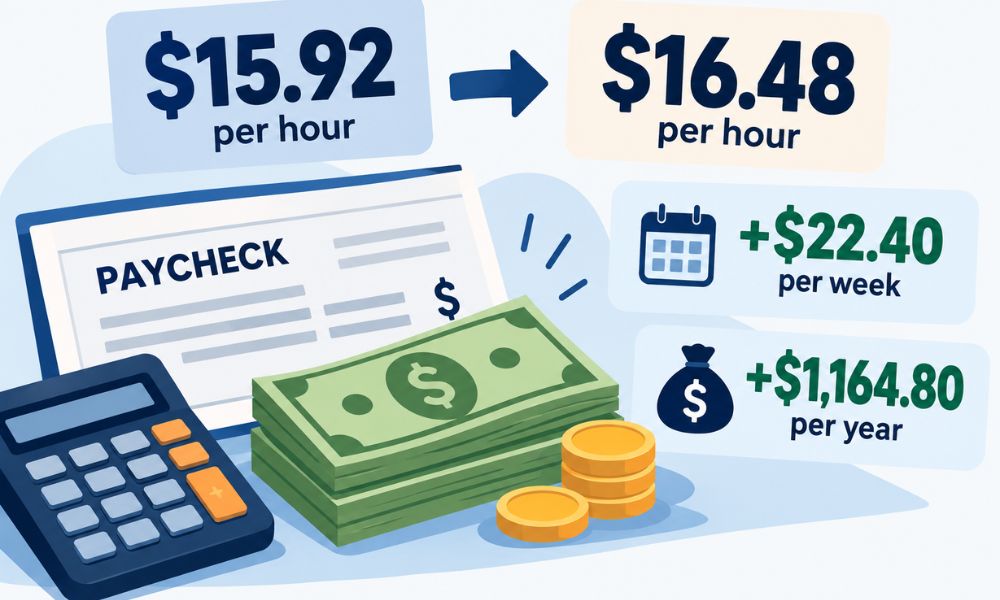
On September 29, the New Jersey Department of Labor announced that the minimum wage for most workers in the state will rise from $15.92 to $16.48 an hour on January 1, 2027.
We read the release at my desk in Pittsburgh, where the Pennsylvania minimum has sat at $7.25 since 2009, so the gap across the state line got our attention before coffee did.
The bigger milestone sits a few lines lower. Farmworkers paid by the hour or by the piece will earn at least $15 for the first time, seven years after the law that promised it.
Below are the numbers, plus what still has not changed.
$16.48/hr
Minimum wage for most employees
$15.92/hr
$16.48/hr
Increase: 56¢ per hour
Every New Jersey Minimum Wage Rate for 2027
New Jersey does not have one minimum wage. It has several, and the one that applies depends on your employer, your industry, and sometimes how you are paid.
The state labor department announcement of the 2027 rates covers five groups.
| Worker group | 2026 rate | 2027 rate | Change |
|---|---|---|---|
| Most employees | $15.92 | $16.48 | +$0.56 |
| Seasonal and small employers (fewer than 6 employees) | $15.23 | $16.25 | +$1.02 |
| Farmworkers paid hourly or piece rate | $14.20 | $15.00 | +$0.80 |
| Long-term care direct care staff | $18.92 | $19.48 | +$0.56 |
| Tipped workers, minimum cash wage | $6.05 | $6.61 | +$0.56 |
The new wage rates also affect seasonal employees, agricultural workers, and long-term care staff.
This TimesXP report takes a closer look at New Jersey’s January 2027 minimum wage increase and what the updated pay rules mean for different groups of workers.
TimesXP explains the new minimum wage rates taking effect in New Jersey on January 1, 2027.
Small employers and farms get the largest raises because both groups are still catching up to the main rate on separate timetables.
Everyone else, including tipped workers and direct care staff, gets the same 56 cents.
What 56 Cents an Hour Looks Like in a Real Paycheck
Percentages make raises sound bigger or smaller than workers feel them, so we converted the main increase into dollars.
Our math assumes 40 hours a week for 52 weeks, a schedule many minimum wage workers never get.

$0.56 × 40 × 52
- $22.40 more per week before taxes
- $1,164.80 more per year before taxes
- $34,278.40 in annual gross pay at $16.48, up from $33,113.60
- A 3.5% raise, slightly ahead of the 3.1% gain in average hourly earnings across the country
If you work in New Jersey, run the numbers yourself. What matters is how much of that $22.40 you take home after taxes.
Why the Increase Is 3.5% and Not a Round Number
Nobody in Trenton picked 56 cents. New Jersey voters wrote an automatic inflation adjustment into the state constitution through a 2013 amendment, so the main rate climbs every January 1 by any increase in one specific federal price index.
CPI-W is the Consumer Price Index for Urban Wage Earners and Clerical Workers, a Bureau of Labor Statistics measure based on the spending of households that live mainly on wage and clerical jobs. Under the New Jersey amendment, its change over the year ending September 30 sets the raise that arrives the following January.
California uses a similar inflation-based adjustment, although the calculation period and resulting increase differ. The state’s minimum wage will rise to $17.40 an hour in January 2027, compared with New Jersey’s $16.48.
We like the design, with one caveat. Indexing protects buying power, but it does not add any. National consumer prices rose 3.4% in the year through August 2026, so a 3.5% raise mostly keeps a minimum wage worker in the same place at the grocery checkout.
Farmworkers Finally Reach the $15 Benchmark
FARMWORKER MILESTONE · 2027
minimum hourly equivalent
When New Jersey passed its $15 law in 2019, farm labor got a slower lane.

The schedule ran to $12.50 in 2024, and the 2019 law required a review by the labor commissioner and agriculture secretary on whether to continue toward $15 by 2027. The increases continued, and farm pay moved from $12.81 in 2024 to $14.20 this year.
Piece rates reward fast hands. Pickers paid by the lug or the bushel learn quickly to convert their haul into an hourly rate, and slower pickers can end a long day well below what an hourly worker would earn.
Did you know? The new $15 floor covers New Jersey farmworkers paid by the piece as well as those paid by the hour, so a bushel rate cannot leave a picker below $15 an hour.
The Farmworker Gap Has Not Fully Closed
Reaching $15 is real progress, but farmworkers will still earn $1.48 an hour less than most New Jersey workers in 2027. Over a full-time year, that difference comes to about $3,078 before taxes.
- Under the state timetable, farm rates keep rising until 2030, when they are scheduled to match the main rate and then follow inflation.
- Farms remain exempt from paying overtime under state law. A farmworker advocacy group, CATA, sued the state over that exemption and the slower wage schedule, and a Superior Court judge allowed the case to move forward in January 2026. I found no final ruling as of early October.
- H-2A guest workers fall under a separate federal floor, the H-2A adverse effect wage rate, and must receive whichever applicable rate is highest.
Small Employers, Seasonal Jobs, and Long-Term Care Staff
Businesses with fewer than six employees and seasonal employers move to $16.25, a $1.02 jump that leaves them 23 cents behind the main rate. The state says their scheduled catch-up increases end in 2028.
Direct care staff in long-term care facilities rise to $19.48, which keeps a $3 premium over the main rate. That number takes me back to my years setting pay bands at a regional healthcare employer. Every time the floor rose for aides, the people one level up asked, fairly, why their gap had shrunk.
Compensation analysts call that compression. A raise at the bottom quietly erases part of the reward for experience, and nursing facilities will face the same question from their senior aides again in January.
Tipped Workers Get More Cash Wage but the Same Tip Credit
Restaurants can still count up to $9.87 an hour of tips toward the minimum, unchanged from 2026. Because the credit stays frozen, the entire 56-cent increase lands on the employer cash wage, which climbs from $6.05 to $6.61. The state explains the details in its rights guide for tipped workers.
- Cash wage plus tips must reach at least $16.48 an hour.
- If tips fall short, the employer owes the difference.
January rate changes do not always reach payroll systems on time, and restaurant payroll is a common place for the old tipped cash wage to linger. A figure like $6.61 looks small on a pay stub, which makes an outdated $6.05 easy to miss for weeks. Servers should check that line on their first January stub.
What to Check Before and After January 1
Workers do not need to apply for the increase or sign anything.
The new rates take effect automatically on January 1, 2027, but payroll mistakes happen, especially in the first pay period of a new year, when old rates linger in software.
- Employers should update hourly rates, tipped cash wages, and farm piece-rate checks before the first January pay run.
- Employers should replace posted wage notices with the 2027 versions.
- Small employers should confirm their headcount, because the $16.25 rate applies only below six employees.
- Workers should compare their first January pay stub with the rate for their category.
- Underpaid workers can file a complaint with the state Division of Wage and Hour Compliance, which accepts claims going back six years.
How New Jersey Compares With Pennsylvania Next Door
$16.48
$7.25
From Pittsburgh, the contrast is hard to ignore. A New Jersey minimum wage worker will earn $9.23 an hour more than a Pennsylvania one next year, about $19,198 over a full-time year before taxes.
Pennsylvania lawmakers have tried to narrow that. The state House passed a bill in March 2026 to reach $15 by 2029, but Senate Republicans blocked a June attempt to force a floor vote. As of early October, we found no new law, so $7.25 remains the Pennsylvania minimum.
New Jersey housing costs more than most of Pennsylvania, and local rents belong in any comparison.
A Raise Measured in Dollars, Not Headlines
For a household living on hourly pay, two dollars more an hour is real news. For a New Jersey farmworker, the climb from $8.85 in early 2019 to $15.00 in January is worth $6.15 an hour, or roughly $12,800 over a full-time year.
The work is not finished. Farm pay still trails the main rate by $1.48, farms still skip overtime, and the court case is still open.
In our running spreadsheet of state wage floors, the 2027 New Jersey farm row gets filled in today. The 2030 row stays blank until the pay stubs actually show it.