
At 10 a.m. Eastern on September 29, I was at my kitchen table in Pittsburgh with my second coffee, refreshing the Bureau of Labor Statistics website while Murray watched me as if I had personally canceled his walk. The August job openings report arrived a minute later.
American workers quit 3.07 million jobs in August, and the quits rate held at 1.9%. Job openings slipped to 7.08 million, the lowest count since March.
None of those numbers is dramatic alone. Read together, they describe a job market where fewer people are leaving and fewer employers are posting.
What the August Job Openings Report Shows
The figures come from the Job Openings and Labor Turnover Survey for August 2026, which BLS published on September 29.
We placed the main lines next to the revised July numbers, since BLS revised every July measure upward.
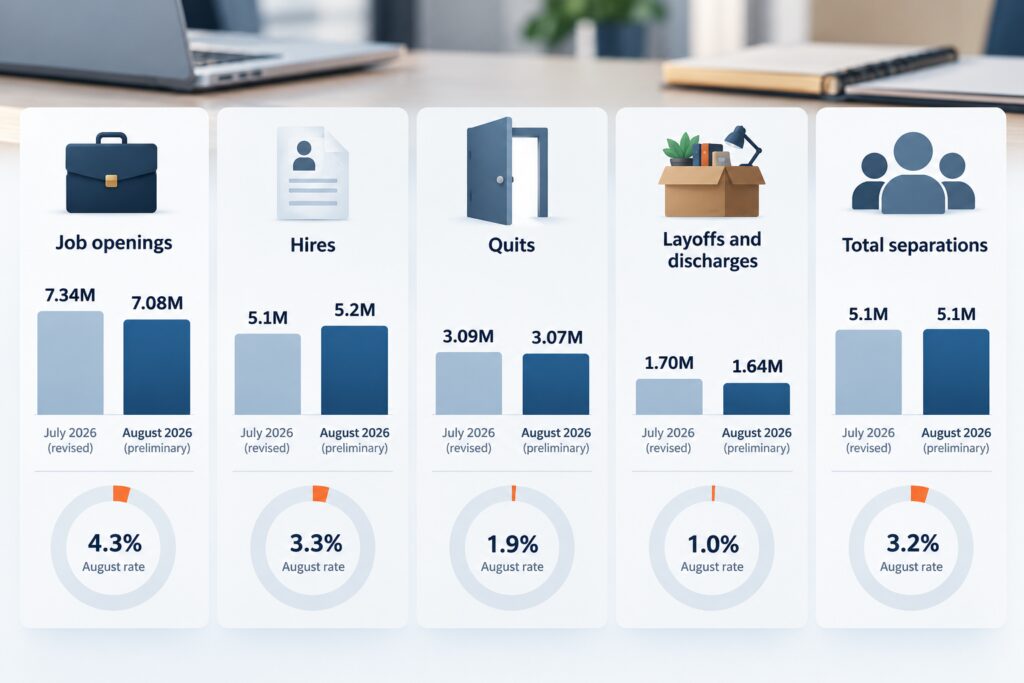
Two details matter before anyone reads too much into the drop. BLS described openings as little changed, meaning the 256,000 decline falls within the normal sampling error of the survey.
Forecasters had expected about 7.2 million openings, according to Associated Press coverage of the report, so August came in slightly below expectations rather than signaling a sudden break.
Why 3.1 Million Quits Is Quieter Than It Sounds
Quits, under the official JOLTS definitions, are employees who left their jobs voluntarily. Retirements and transfers to another location are counted separately as other separations, so the quits figure is a fairly clean read on workers choosing to walk out.
Three million sounds like a crowd heading for the exits. Measured against a workforce of roughly 160 million payroll jobs, it is a calm month.
The quits rate history shows 3.0% in late 2021 and spring 2022, and 2.3% through most of 2019. At 1.9%, August sits below both.
When quits peaked, nearly every office seemed to have someone who announced a resignation on a Monday and was the happiest person in the building by Tuesday.
Today that person is harder to find.
The Five-Month Low Holds Up, but Keep It in Proportion
We checked the headline against the monthly series before repeating it. August openings of 7.079 million are the lowest since March 2026, when the count stood at 6.887 million.
April jumped to 7.585 million, which makes the slide since spring look steeper than it is.

For perspective, openings topped 12 million in March 2022. Compared with the number of unemployed Americans, about 7.03 million in August, the country had roughly one opening per job seeker. In early 2022 the ratio was close to two.
Openings are also the softest number in the survey. A posting shows that an employer is recruiting, not that anyone gets hired, so we give hires and quits more weight. Employers can leave a listing up for weeks while they decide whether they really need the role.
Health Care and Office Jobs Led the Decline in Openings
The industry table for job openings shows the August drop concentrated in a handful of large sectors.
Both of the biggest declines came in fields that employ millions of office and clinical workers.
- Professional and business services fell by 119,000, to 1.19 million openings.
- Health care and social assistance fell by 115,000, to 1.36 million.
- Construction dropped by 48,000, pushing its openings rate down to 2.9%.
- Government openings slipped by 42,000.

Accommodation and food services and retail moved the other way, adding a combined 114,000 openings.
Early holiday recruiting is my guess, though BLS does not assign causes.
The health care figure caught my eye. When we set pay ranges for a regional healthcare employer, hard-to-fill nursing and therapy roles drove nearly every market review, so fewer postings there usually means less pressure on pay.
Who Is Still Quitting
The quits by industry table shows where workers still feel confident enough to leave.
High-turnover service jobs remain at the top, as they almost always do.
- Accommodation and food services recorded 507,000 quits, a 3.5% rate.
- Retail trade recorded 464,000 quits, a 3.0% rate.
- Professional and business services rose from 405,000 to 467,000.
- Wholesale trade fell from 115,000 to 81,000.
- Government held the lowest rate at 0.7%.
Wholesale stood out, with its rate falling from 1.9% to 1.3% in one month.
A drop that sharp suggests wholesale workers are staying put unless another job is already lined up. The data do not show why people stayed, so that reading is ours, not a BLS finding.
Professional and business services deserves a second look too, since its quits rate climbed to 2.1% even as openings in the sector fell.
Layoffs Fell to Their Lowest Level Since March 2025
Layoffs and discharges dropped to 1.64 million in August, a 1.0% rate and the smallest monthly total since March 2025.
Hires came in at 5.2 million, a 3.3% rate that BLS described as little changed over the year.
Labor economists often call that mix low hire, low fire. Employers are not cutting much, and they are not adding much either.
The pattern is an old one. In many working households, a job paying a couple of dollars more an hour was worth a move only when the new position was certain.
Workers in 2026 appear to be making the same calculation. Few are being pushed out, so few see a reason to gamble on a jump.
Staying Put Comes With a Smaller Raise
Fewer quits matter for pay, because switching employers has long been the fastest route to a raise.
The Atlanta Fed Wage Growth Tracker, which follows the same workers over time, put median wage growth for job switchers at 5.0% in August, compared with 3.6% for people who stayed.
Its numbers come from Census household survey data, so it measures individual paychecks rather than an employer average.
On a hypothetical $60,000 salary, that 1.4-point gap equals about $840 a year. Inflation complicates the picture.
Consumer prices rose 3.4% over the year to August, and real average hourly earnings fell 0.3%.
A worker staying in the same job with a 3.6% raise is barely keeping pace, as the grocery bill would reveal long before the next CPI release.
What Happened After the August Report
The August survey is already six weeks old, and the data since then has been weaker.
The slowdown has not affected every industry equally. In fact, manufacturing employment has increased by 72,000 jobs since December, even as hiring across the broader economy remains weak.
The September employment report, released October 2, showed payrolls up just 29,000, unemployment at 4.2%, and July and August job gains revised down by a combined 60,000.
Earlier, on September 16, the Federal Reserve raised its target rate by a quarter point to a range of 3.75% to 4.00%, citing elevated inflation. Both of those are confirmed releases.
What they mean for the fall remains forecast territory. BLS is scheduled to publish September openings and quits on November 3.
That report will show whether the August dip in postings was a one-month wobble or the start of a trend, and I would not call it either way yet.
What We Would Weigh Before Quitting Right Now
If you are thinking about leaving, the numbers argue for patience rather than paralysis.
Openings still run close to one per unemployed person, and employers in retail, hospitality, and some business services kept recruiting in August.
Retail and hospitality jobs remain easier to land, but they also carry the highest quit rates, which says something about how long people stay.
Health care and construction look tighter than they did in spring.
Before resigning, we would want a written offer, a realistic look at the commute, and the raise measured against inflation rather than against an old paycheck.

Our analysis of median job tenure shows workers now stay a median 4.1 years with one employer.
Leaving is less common than social media suggests, and a 5% raise that disappears into gas money is not much of a raise.
The Number You Should Check First in November
On November 3, we will skip past openings and go straight to the quits rate.
A slip to 1.8% would be the lowest reading since spring 2020, and it would suggest workers are getting nervous in a way payroll counts may not show for months.
If it climbs back to 2.0%, that would make the August dip look like a pause.
Circling a Tuesday on the calendar for a jobs report is nobody’s idea of a hobby. We circled it anyway.