
Boeing engineers and technical workers said no in August, and the company came back with more money.
On October 1, members of the Society of Professional Engineering Employees in Aerospace (SPEEA) ratified a four-year contract that raised base pay 10% the next day. The rejected offer had started with 3%.
About 17,000 workers are covered, mostly in western Washington. Reports give the deal as 32% or 36.3%, but both figures describe the same contract measured two ways. We compared the two offers line by line and checked the math. The biggest change was in the pay Boeing now has to guarantee.
How the Two Votes Went
The turnaround took about six weeks. In August, both bargaining units rejected an offer that their own negotiating team had unanimously endorsed, and more than 88% backed a strike authorization.
On October 1, both units approved the revised deal, according to vote totals reported by KIRO 7.
| Bargaining unit | First offer, August 21 | Final offer, October 1 |
|---|---|---|
| Professional (engineers and scientists) | 64.3% no (7,238 to 4,027) | 67.6% yes (7,895 to 3,780) |
| Technical (analysts, technicians, planners, specialists) | 71.9% no (2,795 to 1,094) | 53.5% yes (2,061 to 1,793) |
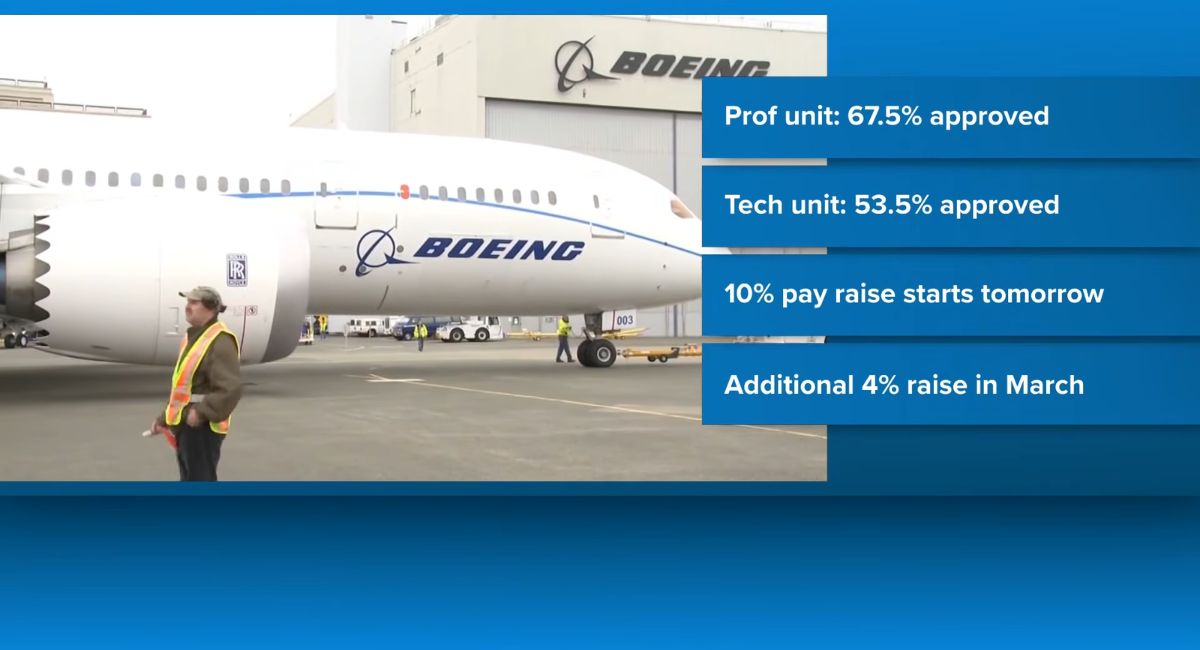
The professional unit swung decisively. The technical unit approved by just 268 votes, a margin thin enough to shape the next negotiation. A strike was possible as early as October 7, the day after the old contracts expired.
Why Members Turned Down the First Offer
On paper, the first offer looked generous. SPEEA called it the largest wage-pool increase since 1983, with a compounded 29.4% over four years. It also offered 40 restricted stock units and three extra days of paid leave.
The weak spot was the word “pool.” Only the first 3% raise was certain. After that, Boeing guaranteed each worker a minimum of zero to 3% a year, tied to inflation, and management divided the rest of each pool.
Members told The Spokesman-Review that a 3% cap would nearly guarantee their pay fell behind, while Seattle-area consumer prices were up 4.5% from a year earlier.
Boeing engineers and technical workers rejected the company’s initial contract offer in August 2026 and authorized a potential strike. Source: KING 5 Seattle.
What is a wage pool?
A wage pool is a share of payroll that an employer sets aside for raises in a year. The pool is fixed, but individual raises inside it vary, so one worker can get well above the pool percentage and another well below it.
What Boeing Changed in the Final Deal
Talks resumed in September, and a second tentative agreement was reached on September 11. Base pay moved the most, but some working conditions improved too.
- A 10% raise for every member, effective October 2, 2026.
- A guaranteed 4% raise in March 2027.
- Wage pools of 6% a year from 2028 to 2030, with a 4% guaranteed minimum for each worker and 2% tied to performance.
- Mandatory overtime cut from 144 hours per quarter to 96 for professionals and 112 for technicians.
- An automatic Boeing retirement contribution of 4% instead of 3% from January 2027 for more than 7,500 members under 40, Manufacturing Dive reported.
Boeing did not move on everything. The union tried and failed to raise the overtime rate again, and the company declined to guarantee specific jobs at each level, according to The Spokesman-Review.
Guaranteed Pay Is Where the Deal Really Moved
Two averages circulate for the final contract, and both are correct.
Adding the raises gives 32%, while compounding them gives 36.3% if every pool is paid in full. We ran the same math on both offers.
| Item | First offer (rejected) | Final offer (ratified) |
|---|---|---|
| Raise at ratification | 3%, retroactive to February 20, 2026 | 10%, effective October 2, 2026 |
| 2027 | 7% wage pool | 4% raise in March |
| 2028 to 2030 | 5.5% wage pool each year | 6% wage pool each year |
| Guaranteed yearly minimum later | 0% to 3%, tied to inflation | 4% |
| Simple total | 26.5% | 32% |
| Compounded total, pools paid in full | 29.4% | 36.3% |
| Guaranteed raises, compounded | 3% to about 16% | About 28.7% |
Our 16% ceiling assumes inflation hits the 3% cap every year from 2027 to 2030.
Under the final deal, guaranteed raises alone compound to about 28.7%, close to the full value of the rejected offer.
In our view, that move from management discretion to certainty explains the yes vote better than any headline average.
The biggest improvement was not just a higher projected raise. It was the increase in pay that Boeing must guarantee to individual workers.
What the New Salaries Look Like
SPEEA projections, reported by KIRO 7, put the average engineer base salary at $208,000 by the end of the contract, up from $152,000 now.
The rejected offer projected $197,000. For the average technician, the projection rises from $119,000 to $163,000, against $154,000 under the first offer.
Those projections line up with the compounded totals in our table, so they assume full wage pools.
A worker with weak performance ratings could finish below them. Seattle pay also has to be read against Seattle costs, a tradeoff we covered when asking whether a job pays more in a higher-paying city.
Did you know?
The rejected offer would have raised the professional unit overtime premium from $6.50 to $8.50 an hour, the first increase since 1989, The Spokesman-Review reported in August. The final deal kept that higher rate.
Why the Technical Unit Vote Was So Close
Technicians gained less from the revision in dollar terms, about $9,000 in projected average pay compared with $11,000 for engineers.
Their mandatory overtime cap also stayed at 112 hours, the same limit the first offer proposed. The technical unit council recommended the deal only cautiously.
Trust is the other factor. In its ratification message to members, SPEEA said its work was not done and pointed to trust that has eroded over decades. We read the 53.5% result as a warning label. Boeing won approval, not goodwill.
Boeing Machinists followed a similar path in 2024, rejecting a first deal by 85% before a 53-day strike, Leeham News noted. Two Boeing unions have now treated a first offer as an opening bid.
What Other Workers Can Learn From the Boeing Vote
Most workers never vote on a union contract, but the same questions apply to any multi-year raise.
We would check four things first.
- Separate guaranteed raises from pools or merit budgets that someone else divides.
- Compare the guaranteed part with inflation where you live, not only the national figure.
- Ask whether a multi-year number is a simple sum or compounded, since the gap in this deal was more than four points.
- Look at when the money arrives, because a 10% raise now is worth more than the same total spread out to 2030.
For a national benchmark, US workers earn about 3% more per hour than a year earlier in recent federal data. That puts a guaranteed 4% raise slightly ahead of typical wage growth, before any pool money.
Frequently Asked Questions
What Comes Next for SPEEA Members
For SPEEA members, the practical result showed up on October 2, when base pay rose 10%. The next fixed date is March 2027, when the 4% raise lands, followed by pool raises with a 4% floor through 2030.
The bigger lesson sits in the first vote. Members turned down a projected 29.4% because too much of it depended on management judgment, then accepted a deal built on guarantees.
If your employer offers a multi-year raise, ask the question SPEEA members asked. How much of it is promised, and how much is only possible?